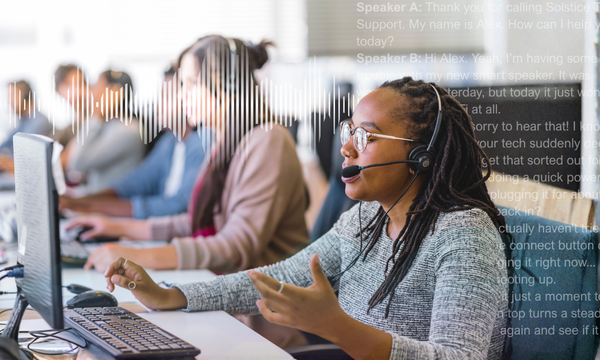
Executive Summary: On-Premises AI Transcription for Contact Centers
What is the challenge with cloud-based call center transcription?
While enterprise call centers and BPOs rely heavily on speech-to-text AI for quality assurance and compliance, cloud-based services introduce three critical vulnerabilities:
- Data Security Risks: Sensitive customer voice files must leave secure corporate boundaries for processing.
- Predictable Cost Spikes: Operational pricing scales linearly and unpredictably alongside shifting call volumes.
- Strict Regulatory Demands: Complex frameworks like GDPR, HIPAA, and PCI-DSS mandate strict, auditable governance over how audio and biometric customer data is stored.
What is the secure alternative to cloud transcription?
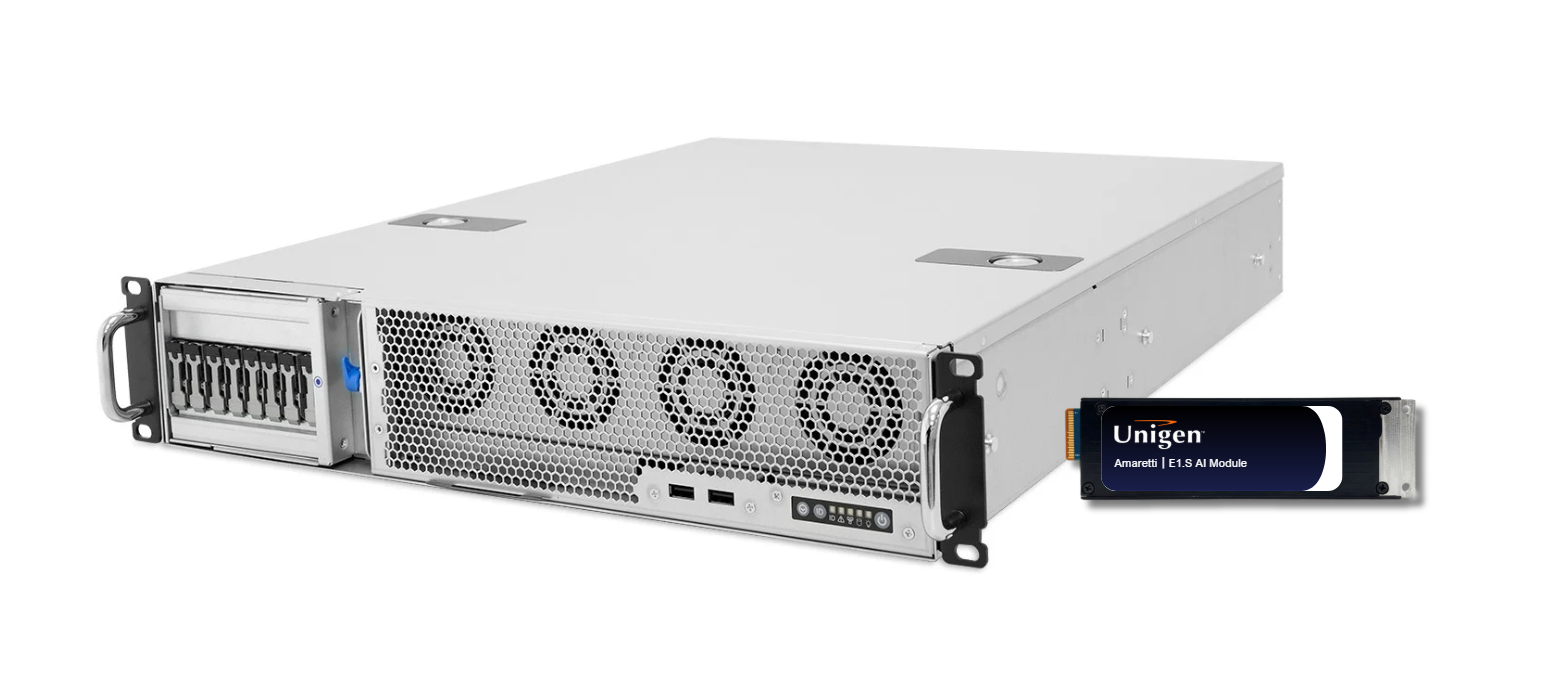
An On-Premises AI Transcription Server moves the entire processing architecture back in-house. Running entirely within your local infrastructure, it achieves localized data sovereignty without sacrificing speed.
How does the Unigen server optimize localized speech-to-text?
Built on the Poundcake-LLM infrastructure, the system utilizes high-efficiency hardware to completely bypass the open internet:
- Advanced AI Hardware: Driven by Unigen AI modules and powered by energy-efficient EdgeCortix SAKURA-II accelerators, the server delivers an industry-leading 6 TOPS per watt.
- Simultaneous High Volume: Seamlessly runs resource-intensive OpenAI Whisper (medium and large) models across 32 concurrent real-time streams.
- Unmatched TCO: Reduces local operational costs to an amortized rate of approximately $0.006 per minute, per channel.
- Native Multilingual Support: Out-of-the-box support for English, Spanish, German, Japanese, and Dutch ensures cloud-level accuracy while guaranteeing that every byte of audio data remains safely enclosed inside your physical facility.
Why Is AI Transcription Essential for Call Centers?
The global speech analytics market was valued at $4.94 billion in 2025 and is projected to grow from $5.70 billion in 2026 to $15.31 billion by 2034, growing at a 13.15% Compound Annual Growth Rate (CAGR) .
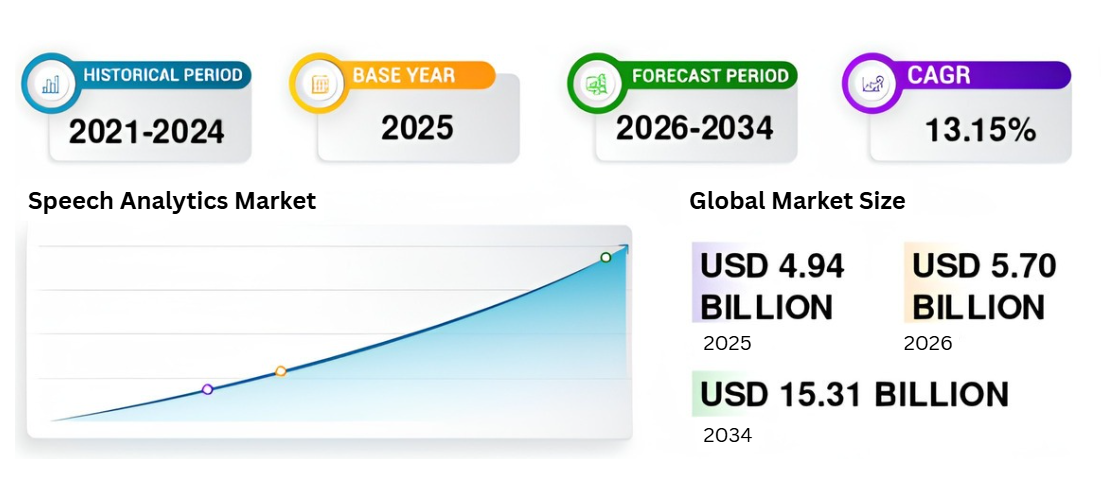
Image Source: Fortune Business Insights
The growth of this market should come as no surprise. As many business owners can attest to, voice interactions are where the most complex (and often the most sensitive) customer issues are resolved.
For call centers handling thousands of daily interactions, AI transcription (the automated conversion of speech into text) is the backbone of modern operations because it allows businesses to:
- Ensure compliance recording for financial regulators (MiFID II, Dodd-Frank)
- Monitor quality across 100% of calls
- Provide real-time coaching to call center employees
- Analyze customer sentiment
- Resolve disputes
Without accurate, timely transcription, these capabilities are impossible to deliver at scale.
Yet despite strong AI adoption in contact centers, a significant portion have not yet deployed speech analytics, primarily citing cost unpredictability, unclear ROI, and concerns about privacy and data security . This gap between adoption intent and actual deployment represents the core opportunity for a more cost-effective, easier-to-deploy solution.
The on-premises deployment model remains dominant in this market, accounting for approximately 70% of speech analytics market revenue (representing a segment value of $3.99 billion in 2026, growing to $10.71 billion by 2034). This trend is primarily driven by strict data privacy requirements in financial services, healthcare, government, and legal sectors .
Challenges with Cloud-Based Transcription
Security and Data Exposure
Voice recordings contain some of the most sensitive data a business handles, including customer financial details, health information, personal identifiers, and proprietary business conversations. Transmitting this data to third-party cloud providers creates exposure at every stage (transmission, processing, and storage).
The risks are not theoretical. In 2023, medical transcription provider Perry Johnson & Associates (PJ&A) suffered a breach that exposed 8.95 million patient records after hackers retained access to its systems for 36 days.
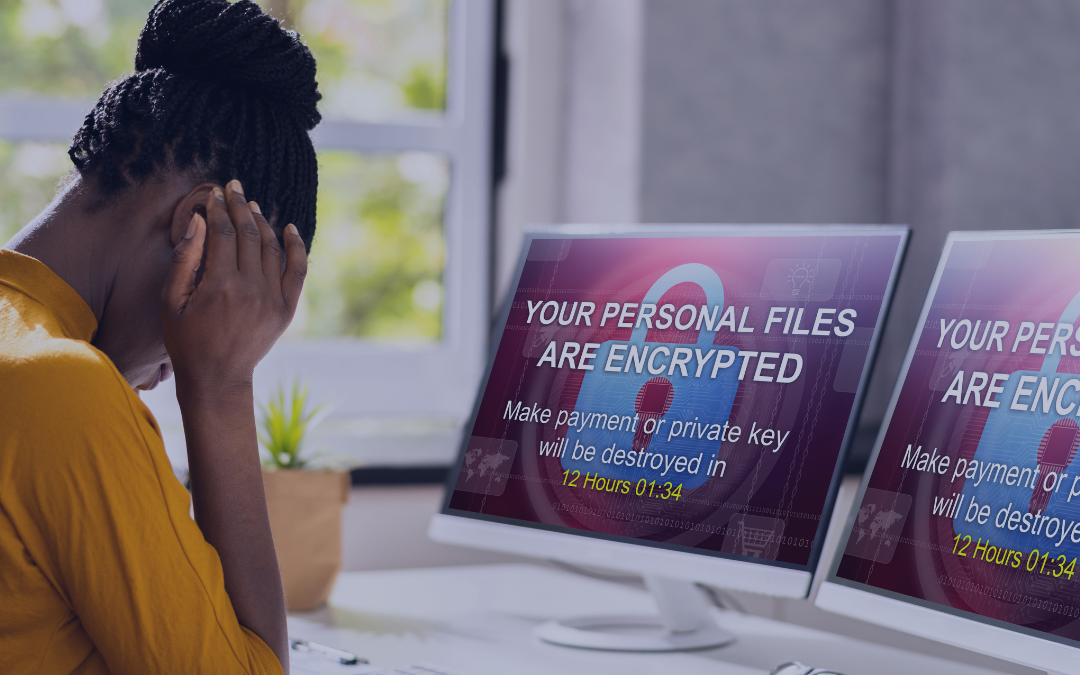
Image Source: Endecom Business IT Solutions
The breach impacted Cook County Health (1.2 million patients) and Northwell Health, New York’s largest healthcare provider. This incident demonstrated the risk of entrusting voice data to third-party transcription vendors.
Regulatory Complexity
Voice data occupies a uniquely sensitive position across multiple regulatory frameworks:
- General Data Protection Regulation (GDPR): Under GDPR, voice recordings constitute personal data and can qualify as biometric data (Article 9 special category) when processed for speaker identification[2]. Sending voice data to cloud providers triggers additional compliance obligations including:
- Data Processing Agreements (Article 28 GDPR)
- Cross-border transfer safeguards
- Vendor security assessments
- Health Insurance Portability and Accountability Act (HIPAA): Under HIPAA, patient voice recordings are protected health information.
- Payment Card Industry Data Security Standard (PCI-DSS): Under PCI-DSS, call recordings containing payment card data must be encrypted and access-controlled, and CVV data must never be stored in any form.
Consequences for Regulatory Non-Compliance
The consequences of failing to comply can be severe. For example, Meta received a €1.2 billion fine in May 2023, the largest GDPR penalty ever, because of data transfers between the EU and the US that did not comply with regulations.
In August 2024, Uber was fined €290 million by the Dutch Data Protection Authority for transferring European driver data to the US without adequate safeguards. GDPR fines can reach up to 4% of worldwide annual turnover or €20 million, whichever is greater.
Top 10 Largest Individual GDPR Fines
| Data Controller | Fine | Year |
| Meta Platforms Ireland Limited | €1.2B | 2023 |
| TikTok Technology Limited | €530M | 2025 |
| Meta Platforms, Inc. | €405M | 2022 |
| Meta Platforms Ireland Limited | €390M | 2023 |
| TikTok Limited | €345M | 2023 |
| €310M | 2024 | |
| Uber Technologies Inc., Uber B.V. | €290M | 2024 |
| Meta Platforms Ireland Limited | €265M | 2022 |
| Meta Platforms Ireland Limited | €251M | 2024 |
| WhatsApp Ireland Ltd. | €225M | 2021 |
Source: GDPR Enforcement Tracker
Expanding and Unpredictable Costs
Cloud transcription pricing appears modest at per-minute rates, but costs escalate rapidly at call center scale. The following table illustrates costs for a typical enterprise workload of 32 concurrent channels operating 24 hours per day across 30 days per month (approximately 43,200 minutes/month).
| Provider | Model/Tier | Cost Per-Minute /Channel | Monthly Cost (43.2K min) |
| AWS Transcribe | Standard | $0.015-$0.024 | ~$648 |
| Google Cloud V2 | Standard | $0.016 | ~$608 |
| Azure Speech | Real-time | $0.0167 | ~$721 |
| Deepgram Nova-3 | Pay-as-you-go | $0.0077 | ~$293 |
| Unigen On-Prem | Whisper Large | ~$0.006* | ~$259 |
*Amortized cost per minute per channel based on hardware lease/purchase over 36 months. Unlike cloud pricing, this cost does not increase with usage.
Hidden costs further inflate cloud bills: data egress charges ($0.08-$0.23/GB), feature add-ons for speaker diarization and personally identifiable information (PII) redaction, medical transcription surcharges (3-5x base rates), and custom model endpoint hosting fees. At enterprise scale, the three major hyperscalers (AWS, Google, and Azure) typically cost from $6,000 to $8,000 a month for 32 concurrent channels operating in real time. This represents an annual cost of roughly $72,000 to $96,000 in perpetuity.
Solution: On-Prem AI Transcription Server
One solution is using an on-prem server for AI transcription. The Unigen On-Prem AI Transcription Server contains all speech processing within an air-gapped, on-premises environment. Voice data never leaves your facility. The system runs OpenAI Whisper, the industry’s leading open-source speech recognition model, on purpose-built AI accelerators, delivering cloud-quality accuracy at a fraction of the power consumption and cost of GPU-based alternatives.
How the On-Prem AI Transcription Server Works
The server integrates directly into your call center’s telephony infrastructure. Audio streams from your private branch exchange (PBX), SIP trunks, or contact center platform are routed to the transcription server over your internal network. The Whisper model processes each audio stream in real time, producing timestamped transcripts with speaker diarization. Without any data leaving your network, transcripts are delivered back to your analytics platform, quality management system, or compliance archive.
The system supports 32 concurrent transcription streams using 32 Unigen AI modules (with one SAKURA-II accelerator per module), with higher performance systems being release later this year. The SAKURA-II delivers 60 TOPS at just 10 watts, yielding a power efficiency of 6 TOPS per watt, which is approximately 3x more efficient than the NVIDIA T4 GPUs commonly used for speech workloads[1].
Multilingual Support with Dialect Adaptation
The Unigen transcription server supports five production languages out of the box: English, Spanish, German, Japanese, and Dutch. Whisper’s multilingual architecture, trained on over 5 million hours of labeled and pseudo-labeled audio, provides strong baseline accuracy across all five languages.
However, production call center audio presents challenges where clean speech benchmarks do not capture regional dialects, accented speech, telephony-quality audio (8 kHz), background noise, and domain specific terminology. The Unigen platform addresses these through on-premises fine tuning with LoRA (Low Rank Adaptation), which trains only 1-5% of model parameters while achieving accuracy near full fine-tuning. This approach enables:
- Spanish dialect adaptation: Caribbean, Argentine, Mexican, and Castilian variants each present distinct phonological patterns. LoRA adapters can be trained and swapped per-call to match the caller’s dialect.
- German regional handling: Standard German is well-handled by the base model, while Swiss German and Austrian variants benefit significantly from fine-tuning. Research shows Whisper achieves approximately 21.6% word error rate on Swiss German without fine-tuning.
- Japanese dialect support: Standard Tokyo Japanese performs well out of the box, while regional dialects (Kansai-ben, Tohoku) require targeted fine-tuning. Research demonstrates that fine-tuning Whisper for Japanese can reduce character error rates by more than 50%.
- Dutch and Flemish: The platform handles both Netherlandic Dutch and Belgian Flemish, with LoRA adapters addressing documented accuracy variations between regional dialects, particularly for speakers from West Flanders and Limburg.
Fine tuning can be performed on-premises using as little as 8 hours of labeled dialect data, making customer-specific adaptation practical without sending any audio data offsite.
GDPR Compliance by Design
On-premises transcription dramatically simplifies compliance with the GDPR and associated national implementations. Rather than managing a complex web of third-party Data Processing Agreements, cross-border transfer mechanisms, and vendor audit requirements, on-premises processing collapses the compliance surface area to a single internal data processing operation.
How On-Prem Addresses Key GDPR Requirements
| GDPR Requirement | Cloud Challenge | On-Prem Advantage |
| Data Minimization (Art. 5) | Audio may be retained by cloud provider for model improvement | Full control over data retention and deletion schedules |
| Cross-Border Transfers (Art. 44-49) | Requires SCCs, transfer impact assessments, adequacy decisions | Eliminated entirely, data never leaves the jurisdiction |
| Right to Erasure (Art. 17) | Must coordinate deletion across cloud provider systems | Direct, verifiable deletion from local storage |
| Data Processing Agreements (Art. 28) | Required with every cloud processor in the data chain | No third-party processors, internal processing only |
| Breach Notification (Art. 33-34) | Dependent on cloud provider’s detection and notification | Internal monitoring and immediate incident response |
| DPIA Requirement (Art. 35) | Complex assessment of third-party processing risks | Simplified assessment with full infrastructure control |
The system also supports compliance with additional regulatory frameworks relevant to multinational call center operations: HIPAA (healthcare call centers handling Protected Health Information), PCI-DSS 4.0 (financial services call centers processing payment card data), and CCPA (California consumer privacy requirements, which explicitly classify audio recordings as personal information).
Transcription Performance
OpenAI Whisper has established itself as the de facto standard for open-source automatic speech recognition. In September 2025, MLCommons selected Whisper Large-v3 as the official ASR benchmark model for MLPerf Inference v5.1, further validating its position as an industry reference.
Accuracy Across Target Languages
Whisper’s word error rates on clean, read-speech datasets provide a performance floor. Real-world call center audio (8 kHz telephony, background noise, diverse accents) typically shows higher error rates, which fine-tuning significantly improves.
| Language | Whisper Medium | Whisper Large-v2 | Whisper Large-v3 |
| English | 4-5% WER | 3-4% WER | 2.7-5% WER |
| Spanish | 5-7% WER | 4-6% WER | 4-5% WER |
| German | 6-8% WER | 5-7% WER | 5-6% WER |
| Japanese (CER) | 8-12% CER | 6-9% CER | 5-8% CER |
| Dutch | 8-12% WER | 7-10% WER | 6-9% WER |
WER = Word Error Rate (lower is better). CER = Character Error Rate (used for Japanese). Benchmarks from FLEURS and Common Voice datasets; actual call center performance varies.
On real-world 8 kHz telephony audio (the standard encoding for call centers), a 2025 Voicegain benchmark across 40 call center recordings found Whisper Large-v3 achieved 86.2% accuracy (13.8% WER), competitive with AWS Transcribe at 87.7% accuracy (12.3% WER) and significantly ahead of Google Video at only 68.4% accuracy.
Hardware: Power Efficiency as Competitive Advantage
The Unigen On-Prem AI Transcription Server leverages EdgeCortix SAKURA-II accelerators, which deliver dramatically better power efficiency than the NVIDIA GPUs used by virtually all competing on-premises transcription solutions.
| Accelerator | INT8 TOPS | Power (W) | TOPS/Watt | Typical Cost |
| Unigen AI | 60 | 10 | 6 | <$1,000 |
| NVIDIA T4 | 130 | 70 | 1.86 | $2,000-$3,000 |
| NVIDIA L4 | 242 | 72 | 3.37 | $2,500-$3,500 |
| NVIDIA A100 PCIe | 624 | 250 | 2.50 | $10,000-$15,000 |
For 32 concurrent Whisper streams, the Unigen server’s estimated total power consumption is approximately 400-500 watts (32 SAKURA-II chips across 32 Unigen AI modules at roughly 256W, plus host CPU and system overhead). An equivalent GPU-based setup would require multiple NVIDIA T4 or A100 cards, consuming 1,000-2,500 watts. This 3-5x reduction in power consumption translates directly to lower operating costs and simplified power and cooling infrastructure requirements.
Benefits of Unigen AI Transcription Server
Cost Predictability
Cloud transcription costs are linear and perpetual: at typical hyperscaler rates, a 32-channel workload costs approximately $72,000-$96,000 per year, indefinitely. On-premises costs are front loaded with hardware CapEx plus installation, then they flatten to operational expenses such as power, which runs $500 to $900 a year for a 400 to 500W system, and partial IT staff allocation. By year three, on-premises total cost of ownership is typically 30-50% lower than cloud. By year five, the gap widens further.
Zero Data Exposure
The entire platform runs on-premises and is fully air-gapped. Source audio, transcripts, fine-tuned models, and all intermediate processing data never leave your environment. This eliminates IP exposure, third-party vendor risk, and the compliance burden of managing external data processors.
Operational Reliability
On-premises systems operate independently of internet connectivity, cloud provider health, and third-party rate limits. Major cloud providers experience multi-hour regional outages multiple times per year. The Unigen server delivers consistent, predictable performance unaffected by network congestion, geographic distance, or external service disruptions. Modules are hot-swappable, so there is no downtime during hardware upgrades.
Customizable AI Models
The system continuously learns from approved improvements, enabling your organization to build proprietary fine-tuned transcription models over time. Industry-specific vocabularies (financial terminology, medical nomenclature, product names), company-specific jargon, and regional dialect adaptations all become part of your internal intellectual property—not shared with outside vendors or cloud providers. Companies can deploy Whisper medium or large models, selecting the optimal trade-off between accuracy and throughput for their specific workload.
Reduced Latency
Due to the modular nature of the Unigen solution, which uses multiple AI modules, latency (wait time) for the next AI module to be ready to transcribe a new incoming call can be reduced compared to relying on a smaller number of large GPUs in a cloud server or needing to add another cloud server to handle increased load. Additionally, the same principles that improve operational reliability also apply to latency: hosting the server on-prem or nearby in a colocation center helps minimize transcription delays during a conversation.
Scalable Architecture
If capacity needs to grow, additional transcription servers can be added at a fixed cost. AI modules can be upgraded when higher-performance solutions are introduced, without replacing the entire server. The E1.S form factor supports hot-swappable modules, enabling capacity changes and hardware upgrades with zero downtime.
Conclusion
AI powered speech transcription is rapidly becoming essential infrastructure for enterprise call centers and BPOs, but the path to deployment must balance accuracy, cost, security, and regulatory compliance. Cloud based transcription services create ongoing exposure of sensitive voice data, unpredictable costs that scale linearly with call volume, and a mounting compliance burden across GDPR, HIPAA, PCI-DSS, and regional privacy regulations.
Unigen’s On-Prem AI Transcription Server gives enterprises a secure, private, and financially stable way to adopt state-of-the-art multilingual transcription without sacrificing performance. Companies can bring AI transcription safely in house by running Whisper on power efficient EdgeCortix SAKURA-II accelerators. This allows them to accelerate their speech analytics capabilities, safeguard customer data, ensure GDPR compliance across European operations, and keep costs low and predictable.
About Unigen AI Transcription Server: Poundcake-LLM
AI Capabilities
- OpenAI Whisper Medium and Large models (up to 1.5B parameters)
- 32 concurrent real-time transcription streams
- 5 production languages: English, Spanish, German, Japanese, Dutch
- On-premises dialect fine-tuning via LoRA adapters
- Approximately $0.06/min/channel amortized cost
Technology
- AIC EB202-CP Chassis, Motherboard, 2 x E3.S Boxes, Dual Power Supply
- AMD Genoa CPU with 16-48 Cores and AVX Media Decoding
- 8-16 Unigen E1.S or E3.S AI Modules (up to 32 EdgeCortix SAKURA-II Processors)
- 256GB DDR5 Unigen RDIMMs
- 960GB Boot Drive (Data Drives Available)
- 2 x 1.92TB E1.S Unigen Data Drives
- 25GbE Networking
- Less than 1200 Watts total power consumption
- Ubuntu 22.04 Operating System
Compliance Support
- GDPR-compliant air-gapped deployment (no cross-border data transfers)
- HIPAA-ready infrastructure for healthcare call centers
- PCI-DSS compatible architecture for financial services
- Active Directory, LDAP, and SSO integration
- Role-based access control and audit logging
About Unigen Corporation
Founded in 1991, Unigen is an established global leader in the design and manufacture of OEM products including SSDs, DRAM modules, NVDIMMs, Enterprise IO, and AI solutions. Unigen also offers a full array of Electronics Manufacturing Services (EMS), including design, quick-turn prototyping, new product introduction, volume production, supply chain management, assembly & test, and aftermarket services. Headquartered in Newark, California, the company operates state-of-the-art manufacturing facilities (ISO-9001/14001/13485 and IATF 16949) in the heart of Silicon Valley as well as offshore in Vietnam and Malaysia. Unigen offers its products and services to customers worldwide targeting a broad range of end markets including automotive, computing and storage, embedded, medical, AI, robotics, clean energy, defense, aerospace, and IoT. Learn more about Unigen’s products and services at unigen.com.
Glossary
- Air-Gapped: A security measure in which a computer, network, or system is physically isolated from unsecured or public networks (such as the internet), reducing the risk of unauthorized access, data leakage, or cyberattacks.
- BPO (Business Process Outsourcer): A company that performs specific business tasks (such as customer service, technical support, or back-office operations) on behalf of other organizations.
- Compound Annual Growth Rate (CAGR): the annual rate of return that shows how an investment grows from its beginning value to its ending value over time, assuming reinvested profits.
- CCPA: The California Consumer Privacy Act, a state privacy law that gives California residents rights over their personal information, including audio recordings.
- GDPR: The General Data Protection Regulation, the EU’s comprehensive data protection law governing how personal data is collected, processed, and stored.
- HIPAA: The Health Insurance Portability and Accountability Act, US federal law protecting the privacy and security of patient health information.
- LoRA (Low-Rank Adaptation): A parameter-efficient fine-tuning technique that trains a small number of additional parameters on top of a pre-trained model, enabling dialect and domain adaptation without retraining the full model.
- PCI-DSS: The Payment Card Industry Data Security Standard, a set of security standards designed to ensure that all companies processing credit card information maintain a secure environment.
- Personally Identifiable Information (PII): any data that can distinguish, trace, or locate an individual’s identity, such as names, social security numbers, or biometric records.
- Private Branch Exchange (PBX): a private telephone network used within companies to manage internal calls and connect to the public switched telephone network (PSTN) for external calls.
- SIP (Session Initiation Protocol): A signaling protocol used for initiating, maintaining, and terminating real-time communication sessions including voice calls.
- Speaker Diarization: the process of partitioning audio recordings into segments based on speaker identity, essentially answering “who spoke when”.
- Whisper: An open-source automatic speech recognition model developed by OpenAI, capable of multilingual transcription across 99 languages.
- WER (Word Error Rate): A standard metric for evaluating speech recognition accuracy, calculated as the number of insertions, deletions, and substitutions divided by the total number of words in the reference transcript.
Sources